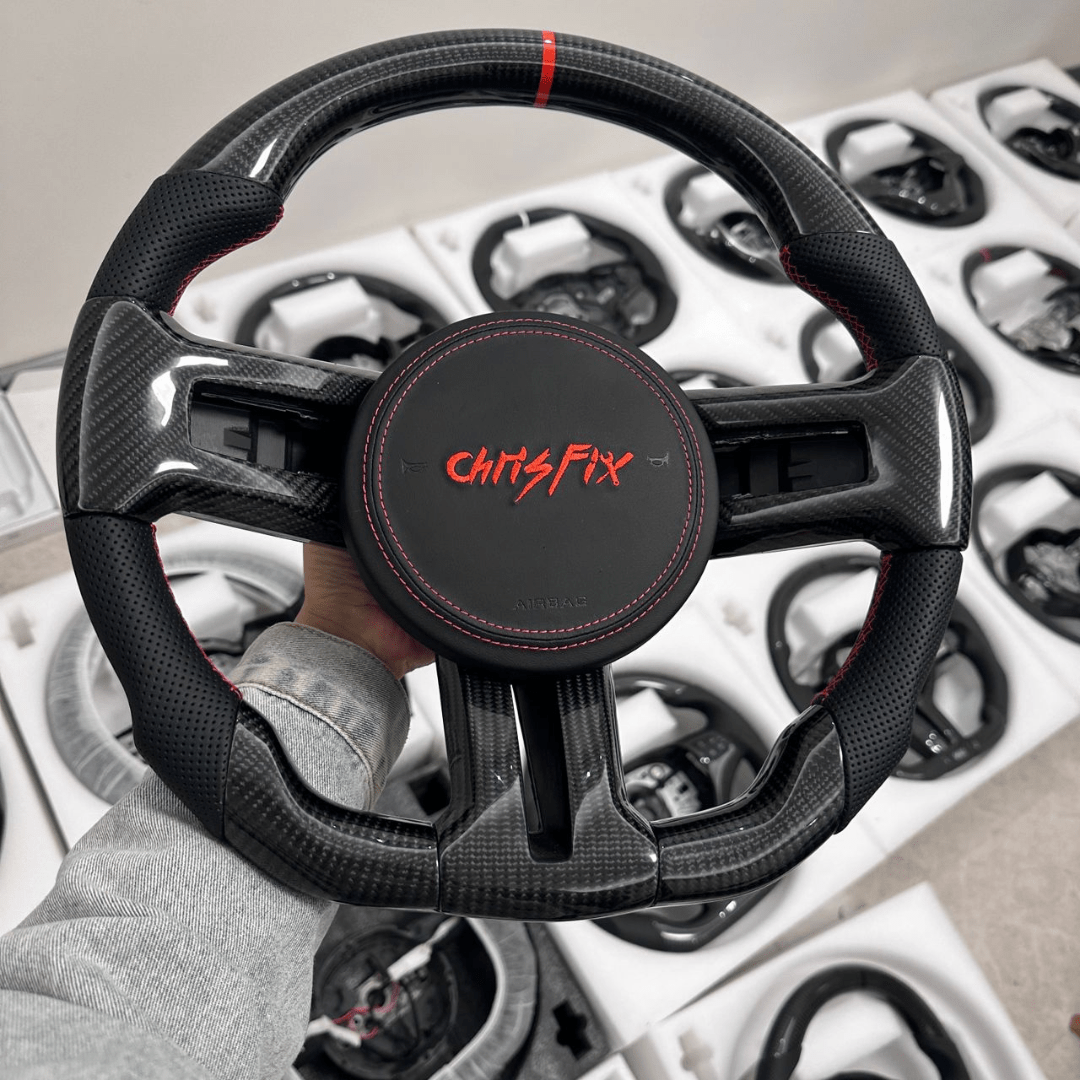

Carbon Fiber Steering Wheel for the MGB GT Roadster: Carbon for the British Sports Car Everyman
Upgrade your steering wheel — custom carbon fiber made for your exact car model.
Shop Now →Why MGB GT Roadster owners upgrade to carbon fiber steering wheels
Sit behind the wheel of a MGB GT Roadster for the first time and the 1962–1980 (chrome bumper and rubber bumper eras) styling codes come through loud and clear, but the helm itself is often the one touch-point that has aged less gracefully than the rest of the car. MGB stewards know the SU carburettor needle charts by heart; they want carbon that matches the British Leyland factory parts book colour. A carbon fiber steering wheel answers that with a material story that reads as pointedly as the MGB badge itself — lighter by several hundred grams, stiffer at the 10 and 2 grip points, and visually aligned with the rest of a modern carbon interior.
For MGB GT Roadster owners the upgrade is rarely about lap times; it is about closing the perceived quality gap between what a SVRA vintage racing and Sunday driver on the Blue Ridge Parkway deserves and what arrived from the factory. A twill rim with contrasting stitching turns the cabin into something that photographs well without turning the car into a parody of itself.
1.8L B-series OHV inline-four character and steering feedback in the MGB GT Roadster
The MGB GT Roadster is powered by a 1.8L B-series OHV inline-four, 95 hp (early chrome bumper) dropping to 62 hp (emissions-strangled late rubber bumper) — and that powertrain dictates how much information you actually want transmitted up the column. Unassisted rack-and-pinion with deliberate heft; the MGB’s long travel and low steering ratio mean every input is a negotiation, and the car is notoriously forgiving to self-taught drivers.
Match the rim to that character. Too thin a profile on a torque-rich platform like the MGB GT Roadster and you will over-correct at part throttle; too thick and the quick inputs the chassis rewards get muted. Most owners land on a 31–32mm rim section in 3K twill, which preserves the feedback envelope while adding visual mass where the carbon weave wants to show.
OEM vs aftermarket carbon fiber options for the MGB GT Roadster
Factory-optioned carbon packages on the MGB GT Roadster were often restricted to centre consoles and door cards. Original MGB wheel was a thin-rim three-spoke Moto-Lita wood; many originals are cracked from UV exposure, making carbon substitutes a common preservation upgrade. That leaves aftermarket builders as the only realistic path to a full carbon rim on most 1962–1980 (chrome bumper and rubber bumper eras) cars.
A reputable aftermarket supplier will start from the original MGB GT Roadster wheel core, retain the OEM spoke geometry and MFL or paddle-shift wiring, and overlay a hand-laid carbon skin rather than a bolt-on cover. The result is indistinguishable from a factory commission — with none of the resale-value risk of a drilled or one-off rim.
Flat-bottom vs round profile for SVRA vintage racing and Sunday driver on the Blue Ridge Parkway
Profile choice is where MGB GT Roadster owners split into camps. Round profile only — flat-bottom on an MGB is almost never seen outside of dedicated Historic Sports Car Club entries.
Consider how you actually use the car. Pure touring on long interstate stints favours a round rim because the thumbs can migrate without catching on a flat section. Autocross, track, and canyon work favour a flat-bottom because thigh clearance matters on aggressive exits and the visual cue at 12 o’clock helps with dead-centre during countersteer.
Material grades — 3K twill vs forged carbon for the MGB GT Roadster
3K twill is the standard weave on most MGB GT Roadster-targeted rims — a 2x2 crosshatch that reads as balanced under direct sunlight and is the most universally flattering grade for a cabin that was never originally trimmed in carbon.
Forged carbon (chopped tow in resin, no visible weave direction) is the alternative that has migrated down from Lamborghini and McLaren parts catalogues. It works on a MGB GT Roadster only if the rest of the cabin has matching forged trim; otherwise the rim looks orphaned. Specify Toray T700 or T800 tow weight for longitudinal strength — and ask the supplier to confirm the layer schedule at the 10 and 2 pressure points.
Installation and airbag/SRS compatibility on the MGB GT Roadster
No airbag; boss adapter is a Moto-Lita 3-bolt to accept period Moto-Lita or Momo Prototipo, and horn slip ring is a BMC part shared with the Midget.
Plan for a fifteen-minute disconnect of the battery before touching the SRS harness, and photograph the clock-spring orientation before you pull the old rim. On 1962–1980 (chrome bumper and rubber bumper eras) platforms the clock-spring centring ring is easy to misalign during reassembly, and a mis-centred ring will throw a light the first time the car powers up. Torque the centre bolt to the manufacturer-specified value and stop; resist the urge to go past the click.
Carbon Clutch — premium carbon fiber for the MGB GT Roadster
Carbon Clutch builds MGB GT Roadster-specific carbon fiber steering wheels with OEM-fit hubs, real twill (not hydrographic film), and stitching drawn up to match your existing 1962–1980 (chrome bumper and rubber bumper eras) interior thread count. Every rim is tested on an OEM core before shipping, which means your airbag module, paddle shifters, and multifunction buttons keep their factory behaviour after the swap.
If you are ready to give your MGB GT Roadster a helm that matches the rest of the car, browse the Carbon Clutch catalogue or reach out for a custom SVRA vintage racing spec. We fit MGB chassis from 1962–1980 (chrome bumper and rubber bumper eras) and will confirm harness compatibility before a single dollar changes hands.
Shop Related Products
Browse Carbon Fiber Steering Wheels for the British performance
Shop British performance Wheels →View All Steering Wheels